Laravel vs Django: Choosing a Backend Stack for Client Work in Kenya
A practical comparison of Laravel and Django for freelance and agency client work in Kenya — weighing hosting costs, local talent availability, M-Pesa integration, and long-term maintainability rather than just technical preference.

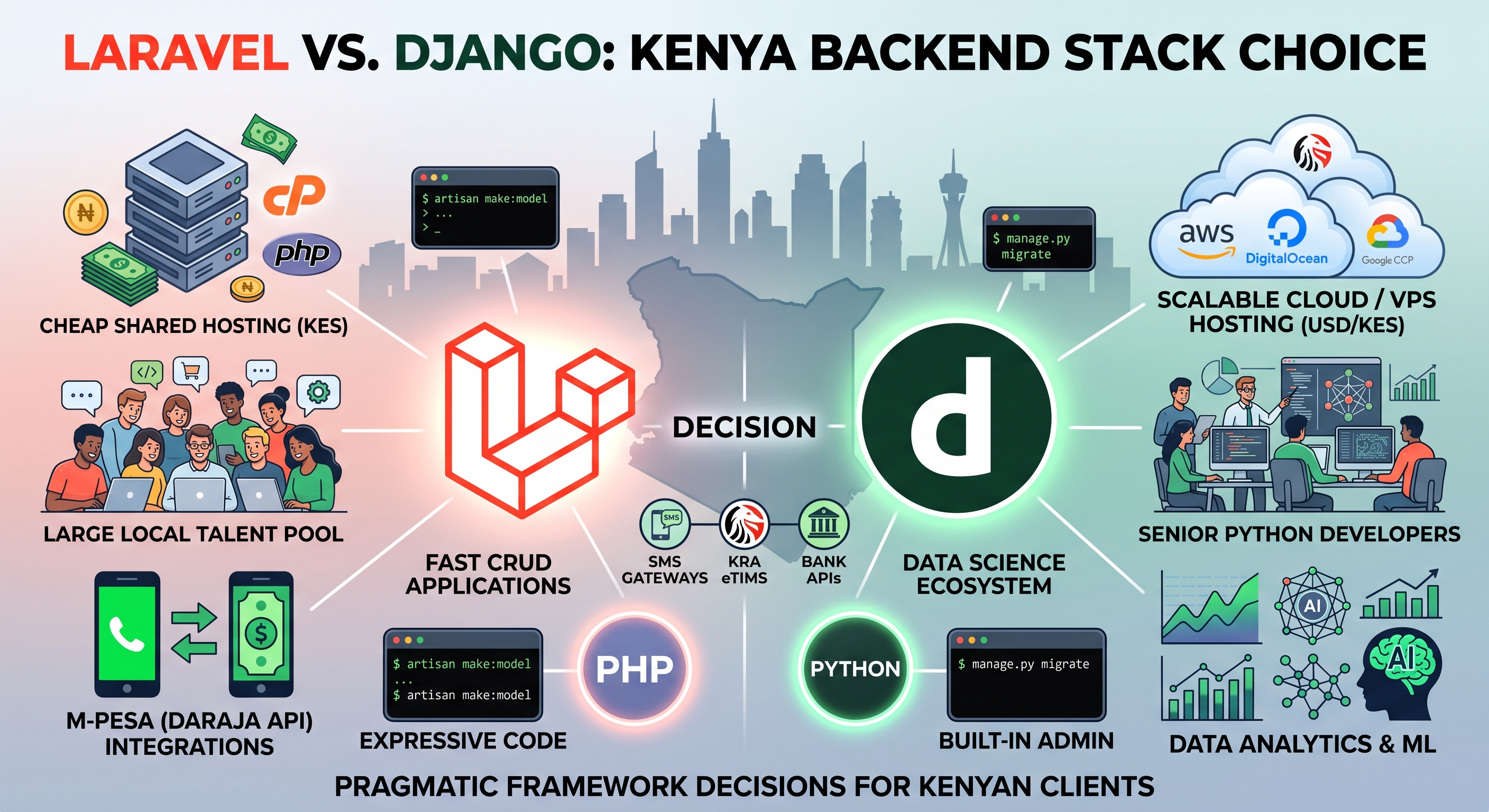
Laravel vs Django: Choosing a Backend Stack for Client Work in Kenya
If you're a freelance developer or small agency taking on client projects in Kenya — SACCOs, SMEs, NGOs, government-adjacent contracts, e-commerce startups — the Laravel vs Django question comes up constantly. Both are mature, well-documented, production-proven frameworks. But the right choice for client work isn't purely technical; it's shaped by local hosting realities, the available talent pool, the tools your clients already use, and how the project will be handed off or maintained after you're gone. This article breaks the decision down across the dimensions that actually matter in the Kenyan market.
Why This Decision Is Different for Client Work
Choosing a stack for your own product is a technical decision. Choosing one for a client is a business decision with technical consequences. You need to consider:
- Handover risk — will the client be able to find another developer if you're unavailable?
- Hosting cost and availability — what's actually offered by local and regional hosting providers?
- Integration requirements — M-Pesa, local SMS gateways, KRA eTIMS, bank APIs.
- Total cost of ownership — not just build cost, but ongoing maintenance and hosting.
- Client technical literacy — will their in-house "IT person" be able to poke around the codebase?
With that lens, here's how Laravel (PHP) and Django (Python) compare.
1. Hosting Availability and Cost
This is often the single biggest practical factor in Kenya.
Laravel (PHP)
- PHP hosting is ubiquitous and cheap across Kenyan hosting providers (Truehost, Kenya Web Experts, Safaricom-affiliated hosts, HostPinnacle, and most cPanel-based shared hosts).
- Shared hosting with PHP + MySQL support starts as low as KES 1,000–3,000/year for small sites, which matters a lot for SMEs and NGOs on tight budgets.
- Many local hosts still don't offer clean support for WSGI/ASGI Python deployments, or charge significantly more for a VPS to run Django properly.
Django (Python)
- Django generally requires a VPS or cloud instance (DigitalOcean, AWS Lightsail, Linode) rather than shared hosting — there's no real Kenyan shared-hosting equivalent for Python the way there is for PHP.
- This pushes minimum hosting cost up, and requires the client (or you) to manage a proper server: Gunicorn/uWSGI, Nginx, process supervision, SSL renewal, security patching.
- For a client who wants "cheap, don't think about it" hosting, this is a real disadvantage.
Verdict: For budget-constrained SME and NGO clients, Laravel's hosting ecosystem is a meaningful cost and complexity advantage. For clients who already run on cloud infrastructure (fintechs, funded startups), this advantage mostly disappears.
2. Local Talent Pool and Handover Risk
You will not be the last developer to touch this codebase. Plan for that.
- PHP and Laravel have a very large developer base in Kenya — bootcamps (Moringa School, ALX, Zetech, university CS programs) all teach PHP fundamentals, and Laravel is the dominant PHP framework taught and hired for locally. Job boards (BrighterMonday, Fuzu, LinkedIn Kenya) consistently show more Laravel/PHP listings than Django/Python for web-specific roles.
- Python developers in Kenya skew more toward data science, automation, and general scripting than toward Django web development specifically. There are strong Django developers here, but the pool is smaller and more concentrated in Nairobi.
- If your client is a small business without a technical co-founder, the ability to cheaply find a replacement developer later matters more than almost anything else. Laravel wins this comparison in most parts of the country outside Nairobi's tech-heavy circles.
Verdict: Laravel has a deeper, more geographically distributed talent pool for straightforward CRUD/business web apps. Django's pool is smaller but often more senior on average, which matters for complex, data-heavy systems.
3. Local Payment and Service Integrations
Almost every serious client project in Kenya eventually needs M-Pesa, and often SMS/USSD, KRA compliance, or bank APIs too.
- M-Pesa (Daraja API): Both frameworks integrate fine — it's a REST API, so any HTTP client works. Laravel has more actively maintained community packages (e.g., various
laravel-mpesapackages) purely because of the larger local dev community publishing them. Django has fewer ready-made packages; you'll write more of the integration yourself, which isn't necessarily bad, but it's more time. - SMS gateways (Africa's Talking, Twilio): Well-supported SDKs exist for both PHP and Python — a wash.
- KRA eTIMS / iTax integrations: Mostly XML/REST-based government APIs with sparse, inconsistent documentation regardless of language — this ends up being custom work either way, so the framework choice barely matters here.
- Bank APIs (Equity, KCB, Co-op APIs): Same story — direct REST integration, framework-agnostic.
Verdict: Slight edge to Laravel purely due to a larger volume of community-maintained M-Pesa packages and Kenyan Stack Overflow/blog content to lean on when you get stuck.
4. Framework Philosophy and Project Fit
Independent of the Kenyan context, the frameworks differ in ways that matter for specific project types.
Laravel is expressive and convention-friendly, with an ecosystem (Nova, Forge, Vapor, Livewire, Filament) built around shipping CRUD-heavy business applications fast. If the project is "an admin dashboard, some public-facing pages, user auth, payments, and reports" — the bread-and-butter of client work — Laravel's built-in tooling (migrations, Eloquent, Blade, Sanctum, Horizon for queues) gets you there with very little boilerplate. Filament in particular has become a strong choice for building internal admin panels quickly, which covers a large share of typical SME/NGO client requests.
Django shines when the project has heavier data-processing, reporting, or ML/analytics components — its ORM, admin panel, and tight integration with the Python data ecosystem (Pandas, NumPy, scikit-learn) make it a natural fit if a client wants dashboards with real statistical analysis, or if the system needs to eventually plug into data science work. Django's built-in admin is also more feature-complete out of the box than Laravel's (which needs Nova or Filament added to match it).
Verdict: Pick based on what the system actually needs to do, not just familiarity. A booking system, e-commerce store, or member portal → Laravel. A data-heavy reporting platform, or anything likely to grow into analytics/ML → Django has the edge.
5. Maintenance and Long-Term Ownership
Client projects often outlive the original contract, sometimes for years, often with no ongoing developer relationship.
- Laravel's release cadence (yearly major versions, LTS support) is well-documented and its upgrade guides are generally clear. Because so many Kenyan developers know Laravel, a client can more easily find someone locally to perform a version upgrade or bug fix years later.
- Django has excellent long-term support policies too (LTS releases), and tends to have fewer breaking changes release-to-release than Laravel historically has — meaning a Django app can sometimes go longer without needing an active upgrade.
- Documentation quality is genuinely excellent for both — this isn't a differentiator.
Verdict: Roughly even on technical merit; Laravel wins on "can the client find someone locally to maintain it in three years" — which, for a lot of Kenyan client work, is the more important question.
6. Team Size and Collaboration Style
- Laravel's conventions (routes, controllers, Eloquent models, Blade views, service providers) are opinionated enough that a junior developer joining mid-project can usually find their way around quickly — useful when client budgets mean you're mixing senior and junior developers on a project.
- Django's app-based structure (each "app" is a self-contained module with its own models, views, urls) scales well for larger teams working on genuinely separate domains within one project, but has a steeper initial learning curve for junior developers unfamiliar with Python's more explicit style.
Decision Framework
Use this as a quick gut-check when scoping a new client engagement:
| If the project is mostly... | Lean toward |
|---|---|
| CRUD app, admin dashboard, member/customer portal | Laravel |
| E-commerce, booking, or subscription platform | Laravel |
| Heavy on M-Pesa/local payment integration | Laravel |
| Data-heavy reporting, analytics, or future ML plans | Django |
| Client already has Python-literate in-house staff | Django |
| Client budget requires cheap shared hosting | Laravel |
| Client already runs cloud infra (AWS/GCP/DigitalOcean) | Either — pick on merit |
| Long-term maintainability by "whoever's available locally" | Laravel |
| Government/enterprise client requiring specific compliance stack | Check client's existing infra first — often dictates the choice |
A Practical Recommendation
For the majority of client work in Kenya — SMEs, SACCOs, NGOs, small e-commerce, membership sites — Laravel is the pragmatic default. It matches the local hosting economics, the local talent pool, and the kind of CRUD-and-payments systems that make up most client briefs. Reach for Django specifically when the project has a genuine data-science or heavy-analytics component, or when the client already has a Python-centric technical team you'll be handing off to.
Neither choice is wrong in isolation — both frameworks are more than capable technically. The mistake to avoid is picking a stack because it's what you prefer, without weighing what happens to the project, and to the client, after the invoice is paid.
Quick Reference Checklist Before Deciding
- Confirm the client's hosting budget and whether shared hosting is acceptable
- Check what integrations are required (M-Pesa, SMS, banking, KRA)
- Ask whether the client has any existing in-house technical staff, and in what language
- Estimate the likelihood of the project needing data/analytics features later
- Consider how easily a different developer could pick this up in 2–3 years
- Don't let personal framework preference override the above
Wrapping Up
The Laravel vs Django debate online is often framed as a technical or even philosophical argument — but for client work in Kenya, the deciding factors are usually mundane: hosting cost, who's available to hire later, and how well the framework's ecosystem matches the kind of app you're building. Weigh those honestly before writing a line of code, and the choice tends to make itself.